Thursday, April 17, 2014

Collector Care Interviews: Lee Shuer

Hello Collectors! I am super excited to feature Lee Shuer on our blog this month.When I first (read) of Lee's story I was touched. He is a Collector who has had the strength and courage to face his hoarding disorder full on , and the passion to help other Collectors do the same. I wanted to know how he did it, not so much the sorting process, but how he kept himself focused internally. As you know, I love self-help, positive thinking and affirmations. What did Lee tell himself during his battles and struggles that kept him focused?

Rachel Seavey: Do you still have urges to find and keep? How do you manage these?
Lee Shuer: Yes. I like stuff, I want stuff, and I still have urges to acquire. But they aren’t as overwhelming as they once were. Back in the day, I couldn’t walk away from a toy sale, free box, thrift store, or tag sale without bringing something home. Today I can go to those same places, confident that I won’t leave with unnecessary items. My priorities have changed.
Lee's "Old" Kitchen

What gives me strength to say “no,” when I need to is the perspective I’ve gained over the past several years of practice. I can see the bigger picture, and the patterns that lead to a cluttered home. I ask myself questions when I find something I want but don’t need. Some of these questions are, “Am I buying it because I can’t find the one I already own?” “Do I have a place to put this?” “Do I have a plan for immediately using it?” And the two most important questions, “Would my wife approve,” and, “Will this help me overcome my clutter problem?”

When it comes to saving things, I ask myself similar questions. Another question that helps in this part of the process is, “Does this item represent who I am now, and who I want to be in the future?” Much of what I have represents different phases of my life. Do I really need those things anymore? Or have I just neglected to look at them that way. I’m not the person I used to be, and I don’t need the same things anymore.
Most of the time these questions work.
Lee and his beautiful wife Becca

Sometimes, and this happens to anyone trying to overcome a long-standing habit, I don’t abide by my own rules. When I notice this happening, I don’t give up. In fact, I see it as an opportunity to put all my skills to the test again. I hear my peers cheering for me as I get back on track.

Rachel Seavey: Happy wife, happy life! I love the questions that you ask yourself, and how aware you are of your finding habit. During your journey, did you lose faith in yourself or the process? How did you regain it?

Lee Shuer: I haven’t lost faith in my process, because I believe that up’s and downs are a part of the process. When I start to have a hard time, I accept it, and use my action plans to move forward again. My WRAP for Reducing Clutter takes these natural patterns into account, and I take responsibility for regaining control.

I recently lost a close family member, and since then, my clutter has reflected the emotional event. I don’t feel like I’m failing, I feel like I’m feeling. I know that this is a part of my grieving process. I’m not acquiring more, but I’m letting things get messy. I know that grief is a trigger for complications in several aspects of my life. Clutter is just one. I know that eventually I’ll start to feel better, and so will my home.

Rachel Seavey: Grief is quite often a trigger for our clients to clutter. It's important to give yourself a break when you are going through a hard time. Backsliding is very normal, and with a positive attitude you can get back on track easier with less guilt. The more you understand yourself the better. It's important to take small steps every day towards your decluttering efforts. This is in order to learn a new routine and so that you don't overload yourself with your own high expectations.
Lee, what steps do you take daily to work on your decluttering? 

"Kaya Lu Bug" and "Honeybee Violet Shuer"
Lee Shuer: Daily maintenance is the key to sustaining a life less cluttered. Am I great at this? No! Am I getting better at it? Yes. I know that one of my biggest challenges is putting my “toys” away after working on a project. Art supplies, music gear, video equipment, electronics…if I don’t re-organize them after I use them, they end up getting piled on top of each other. And so the cycle of chronic disorganization continues. When I clean-up, I break the cycle.

Some concrete chores can help me keep my confidence high and the clutter at bay. Tasks like making sure that the recycling goes out on trash day, or that dishes are cleaned and put away, or that the rug is vacuumed, help me take more pride in my home. My goal is that on any given day, if the doorbell were to ring, I would be proud to give my guest a tour of the house. Every room, every closet. Basement to backyard. A month ago, my home looked great. Today, I’m not as happy with it. A month from now? I know it will look great again, maybe even better than ever! For me there is no real failure in recovery, just opportunity for self-discovery and growth.
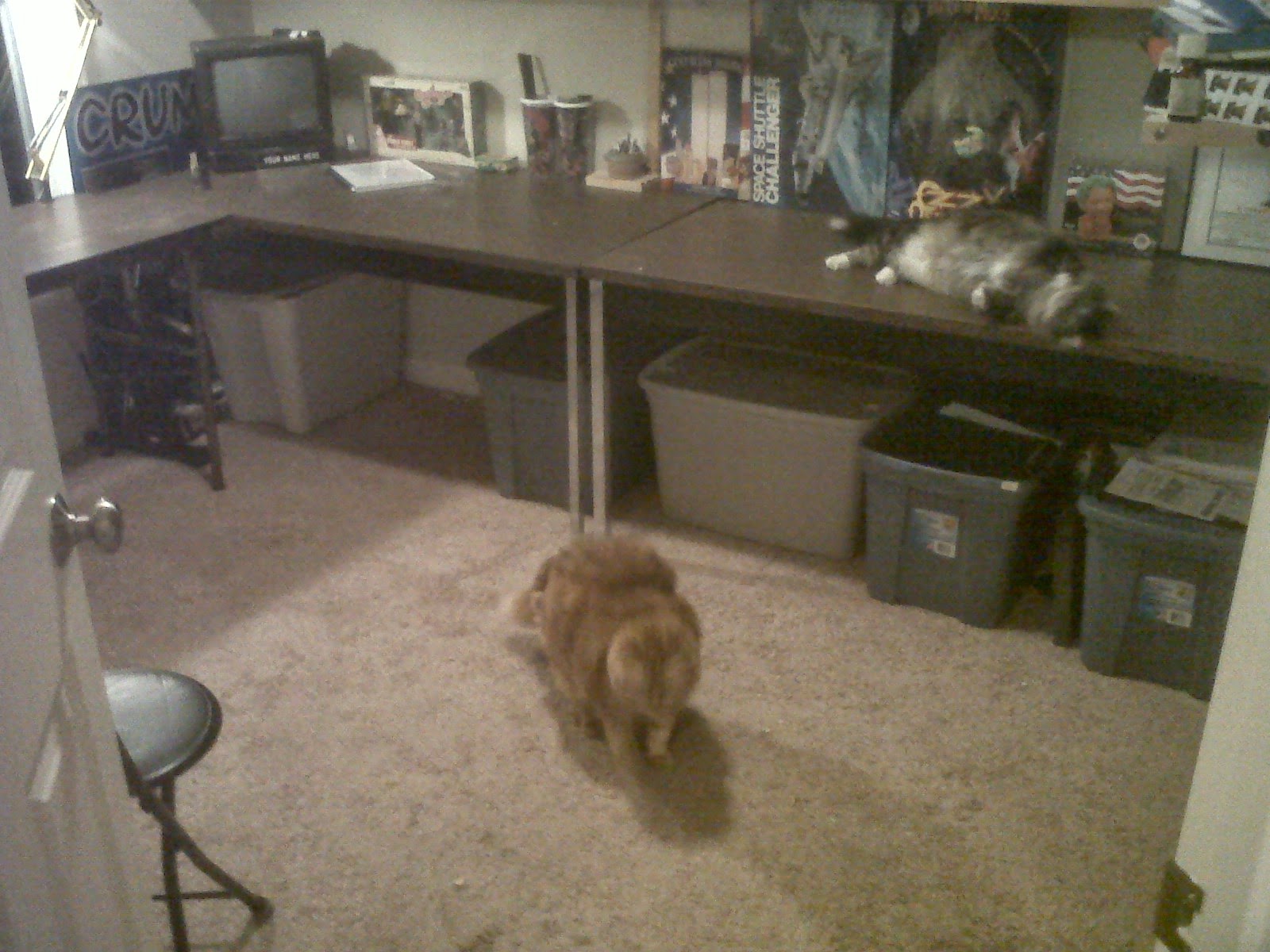
Lee's "Old" Home Office

Rachel Seavey: Making a list of daily chores and sticking to them is an important part of learning how to become more organized. Thank you for being specific on your chores, and so honest about your personal process.  How long has this process taken you? When did you start and when do you plan to finish?

Lee Shuer: I started working on reducing my Finding and Keeping habits back in 2005. Becca, my wife of one year at the time, gave me the ultimate ultimatum: let the stuff go, or I go. This had a lot to do with there not being room in the home for her to have a life. No place for her identity. No space to display her art, or her aesthetic. I had too much stuff.

Lee's Home Office
I accepted help, and started to let things go, and stopped my constant acquiring. That was 9 years ago now. Just this January, Becca said to me, “Finally, this year, I’m happy in our home. Every year we’ve said that next year will be better. It’s finally better.”

That feels great. I’ve worked on this for both of us (and for our three fluffy cats who now have more room to play!) I think I’m past the hardest part of my recovery. My desire to acquire and save will probably never diminish completely, but my skills will be enough to keep those impulses in check.

A big part of my recovery process has been peer support. The folks who have attended the trainings and workshops that I run give me strength and inspire me to be a role model. I am driven by their energy. I want to do as much as I can to help myself and others, through the creation of new interventions and support group models, like the Buried in Treasures Workshop, and Wellness Recovery Action Plan (WRAP) for Reducing Clutter.
Lee's "Old" Living Room

Rachel Seavey: Most of my clients have the hardest time finding where and how to begin. What is your advice for someone with hoarding disorder who does not know how to begin?

Lee Shuer: Ask yourself, “How will life be better if I reduce my Finding and Keeping?” Your answer will be the prize that you keep your eyes on. When the road gets bumpy, and the light at the end of the tunnel seems dim, this hope may keep you moving forward.

I can’t tell anyone how to succeed, because I’m only the expert on myself. But I’ve seen this help a lot of people.

You’re not alone. Millions of us know what it’s like to have too much stuff, and the complications that it leads to. There are options for support and skill-building. Whether you find a Buried in
"Buster Friday Williams" one of Lee's Cats
Treasures Workshop or join a WRAP for Reducing Clutter Group, find a compassionate therapist, have a loving friend or family member, or join a Clutterers Anonymous group or Cognitive Behavioral Therapy group, help is out there. This is an amazing time to begin working on reducing your accumulation. You may even be the support that someone else needs to have success.

Rachel Seavey: Collectors you are not alone. Lee I love the question you suggest to ask yourself
“How will life be better if I reduce my Finding and Keeping?”
Collectors I love this question! It inspires me to transform it into an #affirmation of 
"My life will be better if I reduce my Finding and Keeping."
Lee, thank you so much for stopping by and giving such great answers! I hope our readers find the inspiration that you have found.  

To find out about the most current research and support options for people who collect and clutter go to www.ocfoundation.org or Lee Shuer's website, www.mutual-support.com.

Power to the Finders and Keepers!
Lee's Living Room

Lee's Bio: I am a Certified Peer Specialist, and an Advanced Level WRAP facilitator. I partnered with Dr. Randy Frost to create The Facilitator’s Manual for the Buried in Treasures Workshop. I created WRAP® for Reducing Clutter, based on Mary Ellen Copeland’s Wellness Recovery Action Plan®. I authored The Mutual Support Workbook, for training mental health workers, as well.

Over many years, I have learned to live successfully with my own mental health challenges, and since 2000, I've strived to integrate the best of clinical and peer services. My work has been featured on ABCNews.com, NBCNews.com, Seoul Broadcasting System, Scientific American,
Nature, The New York Times, Le Monde de I'ltelligence, Canadian Public Radio,  WFCR,  P.E.E.R.S. Network Radio, CBS Sunday Morning, and through speaking and training engagements across the United States (and Sydney, Australia, in September 2014!) 

I proudly received citations from the Massachusetts State Senate and House of Representatives for developing meaningful employment opportunities for people living with mental health challenges in 2010, and was awarded the Outstanding Advocate award from the Mental Health Association of San Francisco, for raising awareness about peer support and developing self-help groups for people who collect and clutter, in 2013.
I live in Western Massachusetts, USA, with my wife Becca and our three cats.
"Honeybee Violet Shuer"

Rachel Seavey, Professional Organizer (and blogger) For Collector Care

Collector Care specializes in Hoarding Disorder, Chronic Disorganization and Professional Organizing. We  love what we do, and  provide realistic expectations and timelines. Please visit our website at
www.collectorcare.com  or call 925-548-7750
Tweet us on Twitter : Like our Facebook page : Pin with us on Pinterest

Sunday, April 13, 2014

Collector Care Chronicals: Extreme Cleaning and Hoarding Cleanup

Here at Collector Care no job is too big or small! What happens when squalor or squatters take over a foreclosed or abandoned home? We come in and clean up, that's what happens! I love hearing real estate agents and home owners gasp at the makeover of  the home after one of our deep cleans.
When we arrived to the location of our job we rang the bell but no one answered. I knocked softly, and then harder. Tony gave three hard "police" knocks. "Collector Care, we are here to organize your home this morning" I shouted in my high pitch voice. Shuffle shuffle shuffle we heard some noise behind the door. A small round shadow peeked through the crack of the door "Just a minute!" she shouted "I need to get dressed!" From the crack of the door 50 fruit flies escaped, and we could smell it was a level 5 hoard. We put on our hazmats suits and finished our coffee (not in that order). 15 minutes later she came back to the door, flung it open, and retreated to the back of the house. Taking that as our invitation, we entered the home. The smell of rotten food was overwhelming. It hit us right in the face like a baseball bat when we walked in. Barely getting the front door a foot open, we shimmied in sideways onto two feet of garbage in the foyer. I caught my balance on the side of the wall that was completely covered in black mold and spider webs. Phew, That was a close one, she had a full size broken mirror with glass on top of the hoard and I almost stepped down directly onto it. The commotion of us coming in caused three cats to scatter in all different directions, sending piles and piles of paperwork into avalanches throughout the front room. I think it was the front room, but I could not see any furniture. It was all covered in what looked like clothing, paperwork, food, garbage and human waste. Yes Collectors, when you are an extreme cleaner your nose can tell the difference between human waste and animal waste. I am a mom with pets also. Ok so, we still don't know where our client is but we have our bearings and it aint a pretty sight. "Good morning!" I shouted trying to figure out where she was (my clients love my high pitched voice by the way - especially first thing in the morning).
Our entire crew of six was now at the front door waiting for our instruction - and we needed to all come in and begin work. "In here!" I heard her grumble from the kitchen. You see, she was not excited to see us. Her landlord had told her that she had to clean her place up in 30 days or get out. She had lived there 20 years and the thought of moving elsewhere paralyzed her. She had two days left when she called us. There she was, in her robe, hair a mess, making herself toast in a squalor-ous (or at C2 we say "hoarderific" ) kitchen. My eyes scanned around and saw cockroaches, rat droppings, fruit flies and their droppings, silverfish, lots of pain killers, a ton (literally!) of unopened mail dating back to 1990, 4 trays of rotten strawberries (that's what I smelled!), and the rest kind of just blended in. The garbage heap was quite higher in the kitchen, at this point we were both about 3 feet up. I heard the crew coming in, and setting up in the front room. "The bathroom is broken. I am going to take a nap. Do what you have to do. Take everything but the cats." And there she went with a basket of strawberries in hand. I could see her go into her bedroom (she could not close the door on us due to the garbage) and lay down on top of a completely soiled mattress.  Within minutes I realized what she had meant about her bathroom. There were five gallon buckets throughout the home filled to the brim with human waste. By the end of the day we counted 15. There were cat boxes all over the place, with human waste inside of them. Some were overturned and soiling whatever was below and around it. Bedding and clothing were mixed in, jewelry, bags and bags of loose pocket change, food wrappers, rotten food and rats nests. Full size black widow families were in every corner of the ceiling, draping down there webs to the doorknobs of closets that had not been opened in years. Just another day at Collector Care. Determined to fix the situation we busted our tushies yall, and needless to say we pretty much flipped the place. Her inspection three days later passed, and the landlord personally called with extreme gratitude and amazement. Do you think your situation will shock us? Doubt it. We are non-judgemental, well trained and discreet. Our efficiency and attention to detail is what I pride our company on, as well as being sensitive to all of our clients needs. Call us. We are here to help.


Collector Care Professional Organizers & Extreme Cleaners
Serving Northern California, and anywhere else in the world.
www.collectorcare.com 925-548-7750 rachel@collectorcare.com
Licensed. Insured. Bonded.
Proud ICD Subscribers, and NAPO members.

Thursday, April 10, 2014

4.5 Natural Remedies To Keep Pests Out of Your Hoarded Home

Hello my Hoarding Disorder Collectors out there! I absolutely love working with you all. However, I don't like working with all the unwanted bugs and critters in your home. One problem I come across a lot are pest infestations. I have personally dealt with bed bugs, roaches, fruit flies, black widows, mice, rats and raccoons. I come home with random bites and swollen marks all the time.

And - I know you don't like waking up with a mouthful of fruit flies. I know you know something is scratching every night in the other room.  Let's talk about some easy, inexpensive solutions to help keep those critters out.

Disclaimer: We are not exterminators, we suggest that you please seek professional pest control help first.  Unfortunately (we hear this a lot ) pest companies will not come out and help you if there are not pathways, or clear access in your home. If you find yourself overwhelmed, try these natural remedies:
  1. Essential Oils: Using essential oils such as lemon, orange, clove, peppermint, and mint around the home will deter most bugs as they are turned off by strong odors.(apartmenttherapy.com)
  2. Organic Ant Control. Spray ants with vinegar water. The low pH kills them without
    www.freedigitalphotos.net
    damaging most furniture. This is a great way to clean surfaces while you’re at it.
  3. Silverfish. Aromatic spices like sage, bay leaves and cloves are easy repellents for silverfish, because of their strong smells. You can put these spices inside porous sachets and use hooks to attach them inside your closets or behind your washing machine. You may also fill some decorative baskets with these sachets and lay these baskets near your baseboards.
  4. Rodents. Peppermint and Peppermint Oil. In just about every home remedy circle, you will hear that mice cannot stand the scent of peppermint or peppermint oil. Soak a cotton ball in the oil of peppermint and place it at a suspected entryway.
  5. Remove Food Supply. These pests are here for your crumbs and left
We hope you try out these natural home remedies for the pests in your home. If you still need help call us, and we will come over and help you. We will help you clear a path for maintenance repairs and pest control. We will throw away your urine/feces/whatever infested stuff and deep clean and sanitize your home for you. We will wash the fruit fly droppings of your walls and scrub your kitchen and bathroom clear of silverfish. That's how we roll. No judgement. It's time you start living a little better Dear Collectors, try starting with clearing your home of unwanted pests. 

www.collectorcare.com rachel@collectorcare.com 925-548-7750
Collector Care Professional Organizers are Licensed, Bonded and Insured.

Friday, March 28, 2014

What happens to your STUFF at the landfill?
MOST Importantly, are your documents safe?

As much as I love recycling and despise going to the landfill, in my line of business I have to go at least once a week.

#trashyTuesday
We donate as much as we can to a non-profit charity. However Collectors, we unfortunately are left with items that have to be disposed of. We scrap metal (not for profit) and recycle e-waste as best as we can. This lightens our load and price at the landfill so it's a winning situation for all. If you are actively participating in your home cleanup, you will see the scrap people come and haul those items away.  It can actually be entertaining, if you have that sort of sense of humor.

Okay back to the remains, which is headed to the landfill. This could be important documents (stay with me Collectors, deep breaths), junk, rat infested clothing, whatever! It's in giant black garbage bags, and it's leaving with us.  

What happens to this stuff? And most importantly, are your documents safe? 
These are two questions I hear quite often, and so I thought I would write a blog about it.

First I will tell you in writing what happens, once everything has been approved at the landfill, I will update the media portion at the bottom.

Once your stuff is headed to the landfill there are no stops, except for gas or food for the crew. After all it's been a long day, and our work is still not done for a few more hours.

When we enter the landfill, we stop and are weighed in at the front. We drive over to the area where we need to dispose of your garbage, and we dump it right then and there. We personally (yes even me Collectors) throw your giant heavy bags into a hole. Tractors are going by dumping dirt and there are officials waving you out as soon as you are done. It's all actually quite fast. Sometimes we see the bags being buried and sometime we don't. Per officials, the landfill legally has to cover all the garbage at least once a day. Plus they have machines that are rolling over it trying to compact it. Firecrackers are going off non stop to scare off birds and it's all kind of exciting, except the smell of course. We jump back into our vehicles and head off to be weighed out. That is the process. In and out.

Now. Did you know it is illegal to pick, scavenge, go through anything at the dump? An official told me that once my stuff hits the ground it is HIS. People are not allowed to swap, sell, barter etc. It is illegal. They take this very seriously.

Please read my interview below with  Diana Ratto (Site Manager, Republic Services, Inc.) when I asked her specific questions about the Vasco Road Landfill:

Rachel: What is the difference between a landfill and a "transfer station"?
Diana: Transfer Station - Normally an enclosed area where garbage is dumped and a crew of “sorters” sorts material; i.e.; plastic, metals, cardboard, aluminum, from actual garbage (MSW) (Municipal Solid Waste); such as trash from your kitchen; used baby diapers; non-recyclable material.
Transfer station is where your garbage trucks leave out of in the morning around 3:00 a.m. and start their routes in the neighborhood to pick up your curb side garbage @ homes; Multi-homes; town homes; condo; and then once they pick up from their route; they head back to a transfer station to dispose their loads/garbage to be sifted through by “Sorter”.

Landfill - Final destination of Garbage; material that has already been sorted through from either a transfer station; MRF; IRF. This is non-recyclable material that once it arrives at the landfill is buried. After decomposing then the methane gas is extracted from the refuse/garbage and generates natural gas that provides energy to approximately 4,400 homes in the area.

Rachel: Is it legal to pick through bags of debris? What about employees or workers, are they allowed?
Diana: Answer - NO. 
It is prohibited to salvage through garbage debris at the landfill; it is not permitted.  It is immediate termination of employment if our employee’s salvages through the garbage.
 
Rachel: How long does it take for the landfill to bury your stuff after something is dumped?
Diana: At Vasco Landfill we MUST by PERMIT bury/tarp the garbage every night by 6:30 p.m.  This is a requirement of our Permit.


Rachel: Diana, thank you so much for your time explaining what happens to peoples stuff once it goes to the landfill.

Collectors - So is your tax paperwork from 1982 safe?! What about all that mail with your address on it? Absolutely. Lets think it through my information gathering Collectors.
The thought of: someone jumping into a garbage pit and ripping open tightly tied thick garbage bags, finding your documents ... all the while fighting off giant tractors and officials... um no. Not going to happen. AND if someone did do all of that, they would be in big trouble.

I hope you feel better about your stuff going to the landfill Collectors.

Rachel Seavey, Professional Organizer (and blogger) For Collector Care

Collector Care specializes in hoarding disorder, chronic disorganization and professional organizing. We  love what we do, and  provide realistic expectations and timelines. Please visit our website at
www.collectorcare.com  or call 925-548-7750
Tweet us on Twitter : Like our Facebook page Pin with us on Pinterest

Friday, March 14, 2014

Spring Cleaning in 15 Minutes or Less
from Collector Care

Hey Collectors! It's time for Spring Cleaning! Here are some quick tips to help you along the way. Choose at least one item from the list below and go for it! You can do it.

1. Schedule 15 minutes a day. Just a few minutes will keep your home organized and help you avoid clutter catastrophes.

2. Choose to keep, toss or donate items. Throw away or donate anything old, unused or unwanted. Toss anything damaged or broken.

3. Throw away outside clutter. Immediately toss things like hangers from the dry cleaner, plastic stadium cups and florist’s vases.

4. Throw away any clothes with stains. These do not double as rags. And they can’t be donated. They’re only taking up space.

5. Immediately recycle junk mail. Don’t even bring it into the house.

6. Check for expired coupons. Coupons are awesome, but can easily become an untamed mess. Store everything relevant in one envelope and regularly recycle unwanted or expired coupons.

7. Empty your purse, pockets and drawers of unwanted receipts. Shred or recycle old receipts. You most likely aren’t going to return anything for a receipt over a week old.

8. Choose paperless billing. Most bills can be paid online. It’s the quickest way to prevent piles of paper.

9. Opt out of unwanted catalogs. Call the number listed and ask them to stop sending you mail.

10. Tame your virtual clutter. Clean out your computer. Delete old documents and sort important files in clearly labeled folders.


Rachel Seavey, Professional Organizer (and blogger) For Collector Care

Collector Care specializes in hoarding disorder, chronic disorganization and professional organizing. We  love what we do, and  provide realistic expectations and timelines. Please visit our website at
www.collectorcare.com  or call 925-548-7750
Tweet us on Twitter : Like our Facebook page : Pin with us on Pinterest

Wednesday, March 12, 2014

Hoarder Babe - A story about me from a mystery Collector.

Dear Collectors, thank you for your kind messages and sweet wishes. Whoever wrote this to me is especially creative, and I hope you don't find offense with me posting this online. You were not offended sending it to me right? (winks)

Last weekend I spoke at the San Jose Convention Center (so it's a bit creepy that there is reference to it, were YOU there???) and then I got this in my email. When I responded I got a failure to send message. Who are you Lostin Piles? Give us a call, we offer free estimates!

Hoarder Babe

-------------------------------------
Subject: Hoarder Babe

A desperate message comes in to mild mannered Professional Organizer Rachel Seavey while she is presenting at the San Jose Home Show.

Slipping discreetly into an empty room, no one notices the flash of light. But when she comes out and dashes out the front door all dressed in white, hazel eyes gleaming over her mask, there are gasps... isn't that, yes it is, its Hoarder Babe.

freedigitalphotos.net
Arriving on the scene, she finds a man in front of a garage, buried up to his knees in a landslide of paper. What seems to be the problem sir? "My high school reunion is tomorrow, all I wanted to do was find my old yearbook. I know it’s in here somewhere". 

After quizzing him on the color and size of the book, and when it last looked at it, she slowly crawls on top of the pile. Using the expiration dates of old coupons to lead the way, she zeroes in on a bookcase in the back corner that is peeking through the top of the pile.

"Stand back everyone, this could get messy" she says before disappearing into a cloud of utility bills. After several tense minutes, a blue book " The Santa Cruz High School Fighting Vegetarians, Class of '82" slides down the pile to land at his feet. "Oh Thank You Hoarder Babe". She is about but correct him that it is "Hoarder Woman", but decides to accept it as a compliment. With a wink she is gone.

Back at the convention center, dabbing a little makeup on her wrists to conceal the paper cuts, she smiles and says "Hi I'm Rachel, I'd like to talk to you today about Chronic Disorganization".

By Lostin Piles

Thursday, March 6, 2014

Top 10 Tax Preparation Tips from Collector Care

Top 10 Tax Prep Tips from Collector Care 

1. Start early. You’ll receive tax forms from employers and banking institutions by January 31. Begin gathering everything you’ll need to file as soon as possible.

2. Hire a professional organizer. If your home office is overflowing with paper clutter, hire an organizer to help you gather all your important documents and prepare your tax information to be sent to an accountant.

3. File free. If your income is less than $58,000 the IRS offers free tax preparation software.

4. Make a checklist. Include all the information and documents you need to gather like:
  • Personal information and previous tax returns
  • Information and income for everyone in your household
  • Income from W-2 forms
  • Self-employment income and expenses; 1099 and K-1 forms
  • Education scholarships, loans and interest paid
  • Divorce decree and alimony paid
  • Vehicle expenses such as the cost of parking and tolls
  • Income from rentals or other sources like unemployment, gambling, alimony, etc.
  • Income from retirement, savings and investments
thank you freedigitalphotos.net for this image

5. Itemize deductions only if it’s more beneficial than a standard deduction. If itemizing deductions, you’ll need:
  • Form 1098 or other mortgage statements
  • State and local income tax paid (other than wage withholding)
  • Real estate and personal property tax records
  • Invoice showing amount of vehicle sales tax paid
  • HUD statement showing closing date of home purchase
  • Cash amounts donated to charitable organizations
  • Healthcare costs
  • Expenses related to investments
  • Job search costs and employment-related expenses

6. Avoid the top three most common tax errors:
  1. Claiming incorrect estimated tax payments.
  2. Deducting the wrong amount for the standard or itemized deductions.
  3. Selecting the wrong amount of tax from the tax table on paper tax returns.

7. Can’t file by April 15? No problem. All taxpayers get an automatic six-month filing extension to October 15. The extension is only for filing tax returns and not for payment of any taxes that may be due. Be sure to pay the total tax due by April 15 to avoid penalties and interest.

8. Don’t miss out on a return because you moved. Each year, the U.S. Post Office returns millions of dollars in refund checks as undeliverable. This is generally because taxpayers moved after they filed their taxes. The post office does not forward refund checks. Notify the IRS immediately of a change of address.
9. When to expect your refund:
  1. E-file return: Refunds are processed within seven to ten business days. Direct deposit refunds will reach your bank account within five to seven business days.
  2. Paper return: Direct deposit refunds for paper returns are deposited in six to eight weeks.

10. Reinvest your refund. Instead of spending your refund check on department store sales, invest it in an IRA or deposit it in your savings account. Your future self will thank you. 

Do you need help getting your paperwork together? Hire a Collector Care Professional Organizer to help you get through the daunting task of going through all of and shredding your paperwork.  We will sit by your side and go through it all together, no joke. Is your garage packed with paperwork? Bring it on! We sort through paperwork in bulk regularly and we enjoy it. If your paperwork scares you - don't face it alone. 925-548-7750.